
Attachment Styles Explained: Understanding Your Patterns
In Part 1, we explored how attachment theory serves as a gateway to love and how insecure attachment is deeply connected to the spiritual poverty we've internalized and inherited. Now, let's look at how these patterns show up in our lives and, more importantly, how we can begin to recognize them.
The Attachment Style Categories
One of Bowlby's students, Mary Ainsworth, expanded the attachment theory research with her groundbreaking lab study of "The Strange Situation." In this laboratory study, Ainsworth and her team observed the patterns in infants and toddlers in different scenarios when they were both in close proximity to and separated from their mother. The researchers measured the security of infants through tracking their exploratory behaviors, connection seeking behaviors, and affect displays. Since "The Strange Situation," studies have demonstrated a strong relation between infant security and adult attachment security. Understanding these patterns helps us recognize not only our own attachment styles but also the patterns we see playing out in our relationships and communities.
Learn more about "The Strange Situation."
Secure Attachment
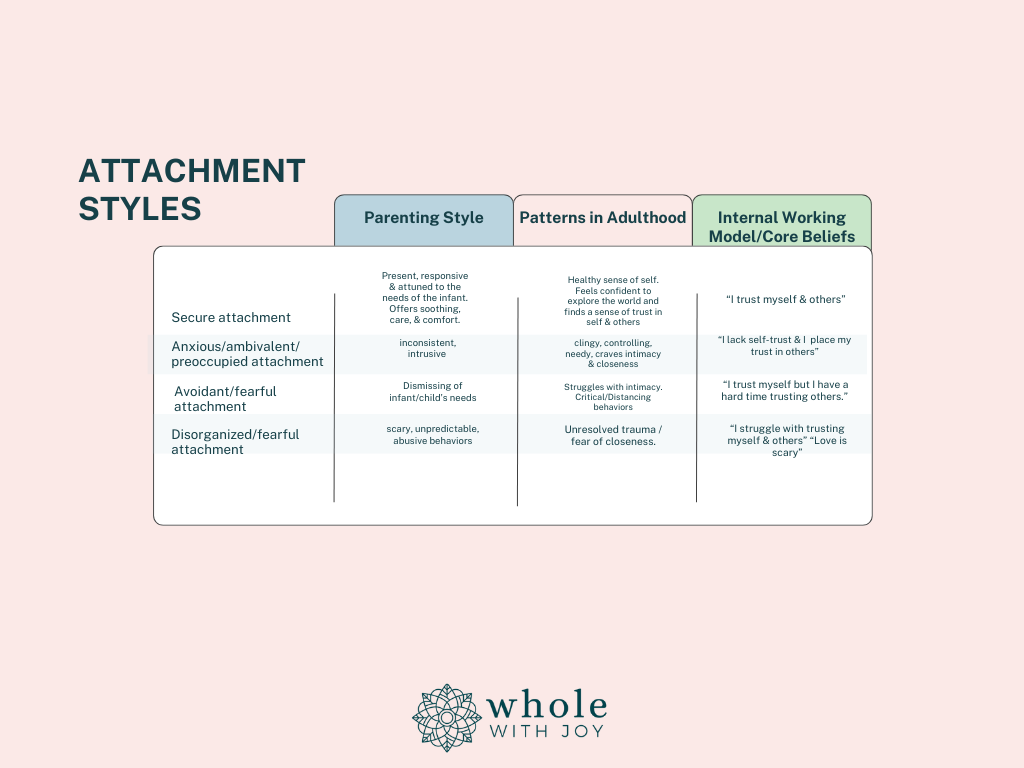
Secure attachment develops when caregivers are consistently present, responsive, and attuned, creating a foundation of trust that carries into adulthood.
Avoidant Attachment
Parenting Style: Caregiver(s) don't have the capacity to meet child's emotional needs. Dismissing of infant/child's needs. Child learns I can't depend on adults in my life to meet my needs and adapts by becoming self-reliant though desiring connection on a deeper level.
Adult Avoidant Attachment Patterns: Struggles with intimacy. Critical/distancing behaviors. Connection is perceived to threaten their sense of autonomy. Self-reliance is a place of comfort.
Internal Working Model: "I can depend on me. I trust myself but I have a hard time trusting others."
Perhaps you've found yourself pushing people away just when they get close, or feeling suffocated when someone expresses emotional needs.
Anxious/Ambivalent Attachment
Parenting Style: Caregiver(s) is inconsistent, intrusive/misattuned parenting. Exhibiting hot and cold behaviors in parenting.
Adult Anxious/Ambivalent Attachment Patterns: Can come off as clingy, controlling, needy due to underlying belief of not being good enough. Fear of abandonment. Craves intimacy and closeness. Wired to be overly sensitive to safety/threat to connection. Often find themselves recreating familiar hot/cold attachment patterns which are harmful to internal safety, well-being, and long-term health.
Internal Working Model: "I have to work hard at getting attention and affection." Lack of self-trust but places a high sense of trust in others.
Maybe you recognize the pattern of seeking reassurance constantly, or the anxiety that arises when someone doesn't respond immediately.
Disorganized Fearful Attachment
Parenting Style: Caregiver(s) displayed scary, unpredictable, abusive behaviors.
Disorganized Fearful Adult Attachment Patterns: Unresolved trauma / fear of closeness. Disorganized. Dissociation. Desires connection/seeks it but then rejects it/runs from it because they were taught love isn't safe and doesn't know how to take it in.
Internal Working Model: "I struggle with trusting myself and others." "Love is scary."
You might notice yourself caught between desperately wanting closeness and feeling terrified when you get it.
Making Sense of Your Patterns
When I first introduce attachment science to people, I find that most are curious. They want to understand themselves. And I always explain that attachment is just one tool, not the whole story, but it gives a meaningful foundation. It helps people make sense of how their early history, childhood, and first relationships shaped how they experience intimacy, what feels safe or unsafe, where they feel open or guarded, and why vulnerability is easy for some parts of them and terrifying for others. It gives language and context, especially if there were wounds in those early relationships or even if there were secure experiences that built a sense of safety.
As I began learning about my own attachment patterns, the most helpful thing wasn't just the information. It was learning how to build awareness inside my nervous system. I started noticing the moments when anxiety, unsettledness, or agitation would rise in my body. Those moments when I'd feel the impulse to pull someone closer or push them away, long before I even said or did anything.
Having even a basic understanding of what was happening inside allowed me to begin self-soothing, self-regulating, and expressing my needs and boundaries with more clarity. It helped me learn how to take care of myself when things felt charged or activated.
What Insecurity Feels Like in the Body
Insecure attachment often feels like an activated fight-or-flight system: on edge, anxious, unsettled, difficulty letting something go, obsessive thoughts, rumination, overwhelm, a sense of threat in vulnerability. Or the opposite: the impulse to flee, shutting down, numbing, emotional distance, feeling aloof or cold. It's like living in turbulent waters, constantly trying to stay afloat, paddling hard, reacting fast, trying not to drown.
What Security Feels Like in the Body
Moving toward secure attachment feels different, softer, steadier, clearer: deeper connection, calmness, openness, the ability to move toward closeness without fear, a sense of inner steadiness, relaxation in the nervous system. It's like the shift from storm water to still water, where you can finally see your reflection. It's like a flower opening because the conditions are finally right: sunlight, rain, space, warmth. It's like the body saying, "We're safe enough now to let joy in."
What I've seen is that when people build awareness of their body and its patterns, the sensations, impulses, and nervous system responses that show up in relationships, what once felt abstract becomes embodied. The story becomes something you can feel, not just think about. From there, people gain more choice, more voice, and more capacity to advocate for themselves. And something beautiful happens: Once people understand themselves better, they can often understand the people in their lives with more compassion, their triggers, their needs, their ways of soothing, and the stories behind their behavior.
Attachment theory is a gateway to love through strengthening the parent-child bond, practicing self-love, and centering universal love. The attachment science underscores the importance of human connection. We are born to attach to others for our survival as a species. How beautiful is this design? It's one that leads us to connection, to each other, to interdependence. We literally need each other to survive.
Here's what gives me hope: attachment styles are not life sentences and they are malleable. Neuroplasticity, the nervous system's ability to change and make different connections, shows us transformation is possible. The suffering that we have become so accustomed to as a society doesn't have to be this way. There is a saying in the attachment world by Diane Poole Heller: "We are injured in relationships and we heal in relationships." No one person finds themselves with insecure attachment in a vacuum, and so it takes healing, loving, reparative relationships to help us move toward security. In Part 3, we'll explore the practices, relationships, and systems that support this transformation, both within ourselves and in our communities.
Curious about your attachment styles? Quiz Here
Ready to go deeper into attachment healing?
If you're ready to transform your relationship with yourself and create the connections that support your healing, I offer guidance through:
1:1 Prosperity Guidance - Personalized support as you remember your wholeness and create the structures that honor your truth.
Prosperity Clarity Session - A single session to explore what healing means for you and the care you deserve as you transform your relationship with yourself.
"Who Are You?" 6-Week Group Program - Beginning January 2026. Journey with others who are also returning home to themselves, integrating all parts, and remembering they were never broken.
About the Author:
Joy Long is a mother, writer, healing artist, ecotherapist and prosperity guide devoted to remembering wholeness in a world shaped by fragmentation. She is the founder of Whole with Joy, a healing movement rooted in embodiment, Earth wisdom, and joy.
Joy’s journey has moved through community mental health, private practice, ecotherapy, movement, ritual, and creative expression. It has also been shaped by years of travel and learning across the African diaspora, the Americas, and other land-based cultures, where the wisdom of place, the centrality of rhythm and movement, and ancestral ways of knowing deepened her understanding of what it means to live in right relationship with self, community, and Earth. Motherhood, ancestral memory, and a lifelong relationship with nature continue to shape both her work and her way of being.
Rooted in earth-based spirituality, somatic healing, attachment healing, and Black feminist and eco-womanist traditions, Joy creates spaces for people to reconnect with themselves, each other, and the living world. Through individual prosperity work, organizational wellness consulting, and community healing offerings, her work invites a remembering: that prosperity is not something we earn, but something we embody when we return home to who we are together, with dignity, pleasure, and power.
References: J Schore; A Schore. Modern Attachment Theory: The Central Role of Affect Regulation in Development and Treatment. Clin Soc Work J (2008); 36:9–20
J Bowlby. Attachment Theory and Its Therapeutic Implications. Adolescent Psychiatry, 6 (1978), p 5–33.